

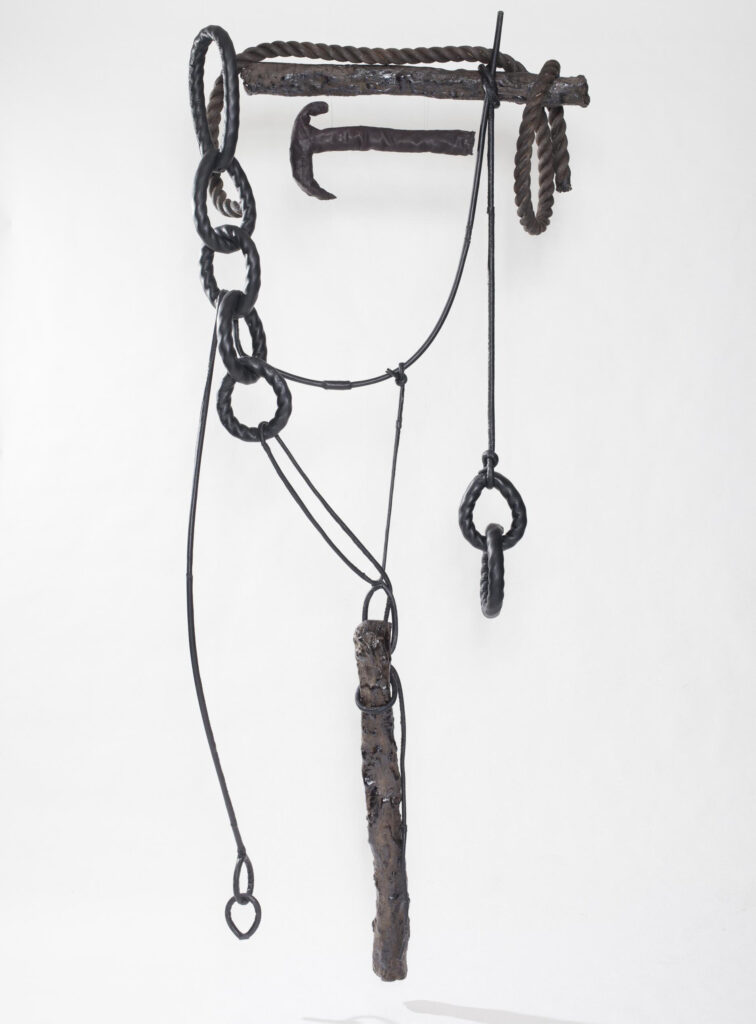

Untitled & Stranglehold (sculptures) (2014)
Danaë Moons described her visual language as drawing-like sculptures and sculptural drawings. In 2013 and 2014, the artist made a number of sculptures and installations. These hanging, holding, strangling sculptures consists of tree branches, wax, epoxy, leather and rubber.
The dark branches hang like bones in space and themes such as tying down and letting go, creating and destroying, seem to merge effortlessly in these works. These sculptures also reveal their fragile nature like wounded creatures and create a visual tension that speaks to psychological and emotional entrapment. As relatives of the drawings, these sculptures too are captured in various constructions of rope, chains, and beams in which a struggle between the freedom of nature and its control becomes visible. The erratic shapes and earthy vitality make the sculptures powerful, but also mystical and tragic.
Essay by Christiaan Bastiaans
“In the presence of the deeply moving works exhibited here, I would like to reflect on the artistic journey of Danaë Moons, whose work forms part of this exhibition, Unknown Landscapes. Danaë was a student of mine at the Rietveld Academy. From the very beginning, her exceptional talent was unmistakable. Even in those early days, she possessed a unique sensibility, a clarity of voice and purpose that was rare. After her graduation in 2010, I remained closely connected to her development as an artist. I visited her studio regularly. These were rich encounters, intense, reflective, often filled with a quiet sense of urgency. I remember one particular visit vividly. Danaë had just begun working on a series of drawings. Some of those early pieces, remarkably delicate and raw, are part of this very exhibition. Her work was never confined to the studio. In 2013, Danaë traveled to Poland. There, she descended deep underground into the coal mines with the miners themselves. This was not an observational journey, but a visceral experience of descent, of labor, of darkness. From that came a powerful video installation, one that is now part of the Bonnefanten Museum’s collection.
Danaë didn’t shy away from the unknown. For a later project, she traveled to Kalimantan, on the island of Borneo, to undertake a journey through the rainforest. There, tragedy struck. The boat she was traveling on broke apart on the fierce Mahakam River. Since that moment, Danaë and her local guide have been missing. Despite extensive and heartfelt search efforts, no trace was ever found. This absence is impossible to separate from her work, it hangs in the air, like breath held. Yet her presence, her voice, remains so alive through the oeuvre she created. Danaë built an impressive and resonant body of work in a short time. Her sculptures, her organic drawings, her video installations, these are not just aesthetic gestures. They echo. They ask. They challenge. Some have drawn parallels between her work and that of Eva Hesse, particularly in the way Danaë pushed material into tension, between fragility and strength, between body and tool. But to me, what makes Danaë’s work truly urgent is how directly it engages with the world we inhabit now, its ecological fragility, its social imbalances, its spiritual exhaustion. Artists like Danaë work at the edge of things. They seek not only to reflect, but to intervene, to offer what philosopher Ivan Illich once called Tools for conviviality. In his 1973 treatise by that name, Illich foresaw a world increasingly dominated by institutions and systems that alienate individuals from their own agency. He wrote:
“I define conviviality as individual freedom realized in personal interdependence, and as such, an intrinsic ethical value… where humans are not enslaved by technology, nor waste unnecessary energy and resources.”
Danaë deeply engaged with this idea. In fact, she once wrote to me a powerful reflection, which I’d like to share with you now: “Industrialized overproduction forces us to use more mechanical energy. It’s become almost unthinkable to develop or modernize with less rather than more energy. We mistakenly believe high culture requires massive tools and energy use. As a result, we are increasingly dependent on machines; society is replacing
people, who are left only to serve the machines. This underlying structure threatens our future. I want to emphasize our relationship with machines. My sculptures are tools, not industrial ones, but born of nature. Yet we are increasingly disconnected from nature. We’ve lost a sense of function, feeling, seasons, and timing. Through my work, I aim to highlight the paradox between nature and industry, both rooted in aggression and power. How do tools affect our human existence? Are we acting today from instinct, or by automation?” These words continue to resonate, because they are not merely theoretical. They are urgent. They are embodied in her work.
To see Danaë’s pieces in this exhibition, Unknown Landscapes, among the powerful and poetic works of other artists, is to be reminded of the role of art in times of upheaval. Not as escape, but as an instrument. A tool. A form of resistance. A way of remembering, imagining, and feeling more deeply. In presenting her work here, among other artists, kindred souls, we are continuing a conversation she began, one that remains profoundly relevant.”
 Danaë Moons