




A Big Window on the World (2025)
A Big Window on the World by Collective Cartographies against Neoliberal Development (Serda Demir, Iliada Charalambous, Santiago Pinyol, Kari Robertson, Julia Wilhelm) is a project in development.
“A Big Window on the World is maybe not a project at all, but an open process of assembling tools, of creating a toolbox.”
A Big Window on the World investigates the tools to make people’s relations, stories, and belongings visible. In the context of neoliberal city planning, territory is thought of as devoid of people, as potentially empty land to generate profit from. Areas such as Rotterdam South are supposed to be ‘improved’, by displacing the existing working class population through a middle class population that brings more disposable income to the area. The policy makers claim that the working class people inhabiting the land have a ‘small window on the world’, which to them justifies the need for top-down ‘improvement’. To them, the inhabitants of the neighbourhoods are mere numbers that can be moved around. As if people had no relation to their neighbourhood and as if the area wasn’t constituted, transformed, and shaped by its inhabitants.
A Big Window on the World asks what a map of a given territory looks like if the people who inhabit it – not the potential profit – comes first. If we don’t think of land in terms of its possible economic value, what are other forms of value? Values such as memories, relationships, the neighbourhood shop you visited since you were a child, the tree you observe from your window and watch change throughout the seasons and values such as the children who play on the football field every Thursday evening.
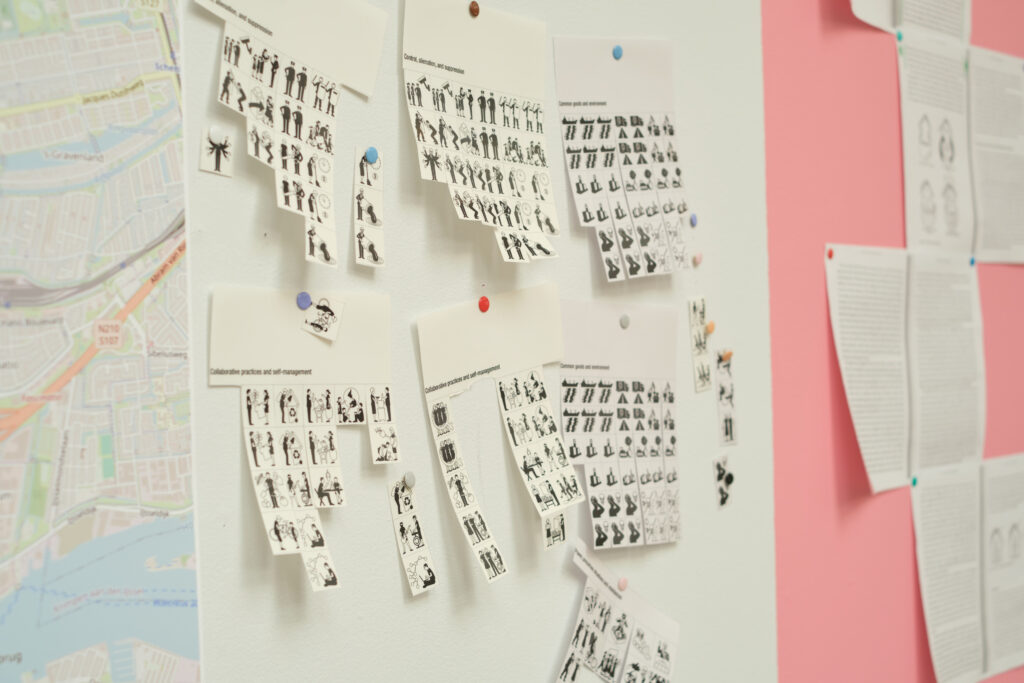
A Big Window on the World by Collective Cartographies against Neoliberal Development (Serda Demir, Iliada Charalambous, Santiago Pinyol, Kari Robertson, Julia Wilhelm) aims to map this conception of ‘land value’, tracing the existing exploitative infrastructures, that we need to challenge. Inspired by the Argentinian mapping collective Iconoclasistas: maps are tools of power. How can we reclaim maps as tools for the many? What kind of mapping processes can affirm other values?
A Big Window on the World starts from the local context of the neighbourhood to think through global, neoliberal infrastructures of violence and exploitation and mechanisms of gentrification (building on settler-colonialism). The existing racialised population is supposed to be replaced by affluent white people. The language of development is employed to portray this process as inevitable, natural or even beneficial. Often, it is the very same institutions who benefit from these processes. “In a globalised world, there is no such thing as an isolated territory, the local is inextricably linked to the global. Our answer to their globalisation is internationalism and solidarity.”
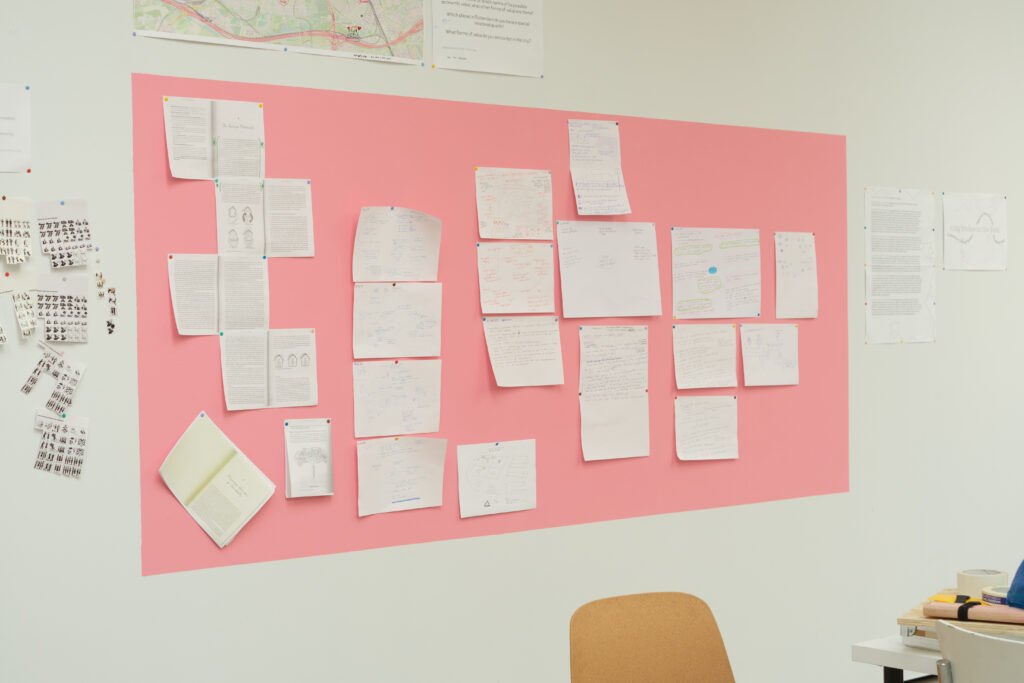
A Big Window on the World is a humble beginning. During the timeframe of the Underdeveloped #2 exhibition, Collective Cartographies against Neoliberal Development (Serda Demir, Iliada Charalambous, Santiago Pinyol, Kari Robertson, Julia Wilhelm) will be meeting in the exhibition space in irregular intervals to read, discuss, draw, and map together. “As a visitor of the space, you are invited to join us at the table. We aim to use the space of this exhibition to develop a toolbox that can be applied in the context of local struggle.”
 Collective Cartographies against Neoliberal Development (Serda Demir, Iliada Charalambous, Santiago Pinyol, Kari Robertson, Julia Wilhelm)